Small business bill seeks to increase employment

In an effort to increase hiring among small businesses, lawmakers in Congress recently proposed a new piece of legislation to lower taxes.

The proposal, which would cut small business taxes by $29 billion, survived a preliminary vote in the Senate and would allow firms to get tax credits of up to $500,000 if payrolls increase by more than $5 million. The provisions would also allow businesses to deduct expenses stemming from purchases of new property and equipment made this year.

Those who are in favor of the Small Business Jobs and Tax Relief Act say that the money firms save would help increase employment levels.

“This tax cut is not a cure-all, but it could be a difference-maker for small firms on the fence about adding payroll,” said Sen. Charles E. Schumer (D-N.Y.), according to The Associated Press. “After last month’s sluggish jobs numbers, we may be on the verge of a rare moment of agreement on how to help the economy.”

According to analysis from Regional Economic Models, passage of the bill would result in 990,592 new jobs, adding $87 billion to the gross domestic product of the U.S.


Fast-growing firms need to be able to hire quickly

Thanks to new technology, many firms are able to receive a greater response to announcements of open positions than ever before. Adding staff in a quick manner is one of the most important things, especially for companies that are expanding at a rapid pace.

In one case, social media management company HootSuite saw its user base increase to 4 million just four years after its initial launch. As a result, it needed to add staffers at a quick space. However, one of its issues was that its human resources department wasn’t equipped to handle the flow of resumes, Forbes reports.

To help with operations, Hoodsuite began using The Resumator, a piece of software that makes it easier to organize information.

“Big companies have had access to powerful HR tools for the past twenty-five years,” said Don Charlton, the HR firm’s CEO, in an interview with the source. “Unfortunately, such enterprise solutions require a crushing amount of care and feeding and are inappropriate for small-to-medium sized companies. In addition, they do not suit the fast-paced hiring environments typically found at smaller companies.”

While the unemployment rate has largely remained flat over the past few months, there are signs that a recovery could be around the corner. The 2012 Allied Workforce Mobility Survey revealed that two-thirds of human resources workers said their firms would be hiring before the year ended.


BLS Employment Situation Report: June 2012

The Labor Department reports that the U.S. unemployment rate
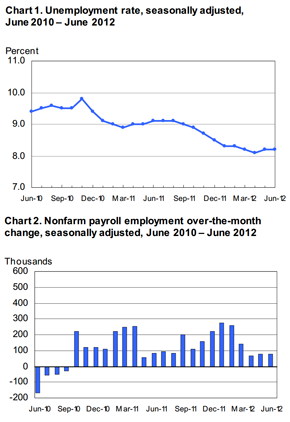
remained unchanged in June at 8.2 percent while adding 80,000 jobs,
mostly in the professional services sector. The first quarter of
2012 averaged a gain of more than 225,000 positions per month,
while the second quarter averaged just 75,000.

Despite being above average for the quarter, June’s figures were
some of the most negative of the year. While 47,000 professional
services jobs were added in the month, nearly half of those were
temporary positions. The healthcare sector, which has averaged
nearly 30,000 positions per month over the last year, added just
13,000 jobs during the month. June, however, saw the Affordable
Care Act’s individual coverage mandate upheld by the U.S. Supreme
Court, setting the stage for insurers and health care providers to
begin preparing for a substantial increase in their patient base
within 30 months.

The business, management, and related occupations unemployment
rate fell from 4.7 to 4.4 percent year-over-year with the largest
decline occurring in the management, business, and financial
operation segment, where it fell from 4.6 to 3.8 percent. The
bachelor’s degree and higher unemployment rate, which is seasonally
adjusted, rose from 3.9 percent to 4.1 percent as both the size of
that population and its employed portion fell.

In 2011, employment growth also slowed during the summer months.
Yet, June was the first month of 2012 to report lower job growth
than the year before. Economists project employment gains will
rebound moving into the fall, rising to a monthly average closer to
120,000 positions gained. However, even at that level, growth will
not be enough to meaningfully move the unemployment needle.

While June’s employment report was clearly one of the most
sobering of the year, it also points to a broader trend of less
movement in the labor market. While hiring has not been high,
layoffs have been even lower. General merchandise stores were the
only sector to see significant decreases in their employment, down
12,500 positions. Employers have continued to adopt a wait-and-see
attitude as activity on several fronts-especially for non-critical
roles-has slowed. Though what employers are waiting for-a
resolution to the euro debt crisis, implementation of the
Affordable Care Act, the U.S. presidential election, the fiscal
cliff-remains unclear.


BLS Employment Situation Report: May 2012

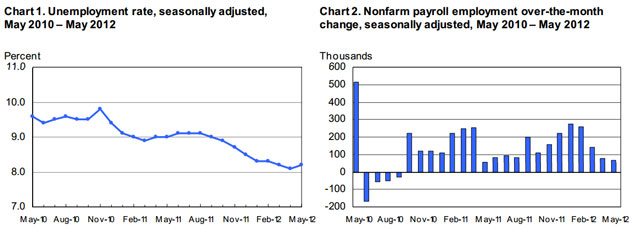
Total employment in the U.S. grew by 69,000 positions in May and unemployment grew for the first time in more than a year from 8.1 to 8.2 percent as nearly half a million high school and college graduates entered the workforce. Revisions to April’s employment numbers showed that just 77,000 jobs were added that month, rather than the 115,000 first reported.

Healthcare, which has continued to be a stalwart of growth, was the top-growing industry segment in May, adding 33,000 positions. Close behind was transportation, where 20,000 passenger ground transportation jobs were added. Wholesale trade and manufacturing also both tended upward during the month, adding 16,000 and 12,000 jobs, respectively.

On the whole, professional and business services were essentially flat, but within that grouping, accounting and bookkeeping services trimmed 14,000 positions in the post-tax season. The losses were counteracted by gains in temporary help services, 9,200, and computer systems design and related services, 5,300. The unemployment rate of people in management, professional, or related occupations was down to 4.0 from 4.4 a year ago.
Some of the largest losses outside of accounting were services to buildings and dwellings, 14,300, specialty trade contractors, 17,700, and amusement, gambling, and recreation, 16,600. Although these losses were drawing down the total number of jobs gained in May, it is worthwhile to note that they are seasonally adjusted numbers in largely seasonal industries. In fact, in unadjusted numbers, services to buildings and dwellings grew by 61,200, specialty trade contractor by 96,500, and amusements, gambling, and recreation by 75,800.

In total unadjusted numbers, 789,000 jobs were added in May, largely being filled by students graduating high school and college. Seasonally adjusted numbers are important in understanding the month-to-month trends in total employment. Yet, they can give the impression that doormen, carpenters, and blackjack dealers are being laid off en masse. While some invariably are laid off in any given month, in May their hiring was just not as robust as a typically May, which is understandable in the current climate.

Europe’s economy is–at best–at a standstill, China is decelerating, and the U.S. presidential election entered its general phase with key issues regarding business regulation, and fiscal and monetary policy being sharply debated. Despite these uncertainties, employers are hiring for the crucial roles that need to be filled. May’s report was not a glowing opus on the state of the employment market, but it was far from a disaster. It will be several months until a more definitively negative–or positive–trend can emerge from an economic climate that continues to be draped in a degree of uncertainty.

Technology firms step up hiring efforts in California

When it comes to hiring the most talented workers, technology firms must compete against one another to attract qualified candidates to fill open positions. Perhaps the most popular region for these firms is Silicon Valley in California.

The Mercury News reports that many of the biggest names in the tech sector converged in Palo Alto for the Tech Career Expo, looking for the most qualified computer science professionals for various roles. According to Doris Keller of IntApp, who represented her firm at the event, there is a shortage of people with the right skills, so firms were hoping to set themselves apart and attract the attention of job seekers.

"We're all competing against each other and against the headhunters," said Keller said in an interview with the newspaper. "We've got eight positions we're trying to fill, but there's a finite number of available and qualified candidates. So that explains the disconnect here."

On the East coast, there are also a number of opportunities for tech professionals. In April, the NYC Startup Job Fair attracted some of the top firms in the sector, looking to hire new workers.

Searching for Perfect Candidate May Miss the Perfect Match

When hiring managers begin to write the list of qualifications,
they build lists of everything they think they want in a candidate.
It’s a process not unlike building a dating profile; pulling
characteristics out of the air to describe the perfect match. In
dating, people tend to understand that finding someone who matches
that description is unlikely. When they find someone they like, it
is almost a coincidence when they match even the broadest elements
of the original profile.

By contrast, hiring managers frequently use far less latitude in
their candidate searches. The descriptions involve far more precise
requirements and they are less likely to waiver on them should
someone outside of the criteria apply.

???Using vetting of candidates based on stringent requirements
can keep out the candidates who have no place in an organization,
but there isn’t an automated filter that is going to increase your
ability to identify, much less attract impact players to your
organization. There isn’t an accredited Master of Innovative Thinking degree or
Doctorate of Self Starting, and a resume that claims someone has
such qualities only means they know those skills are
important.

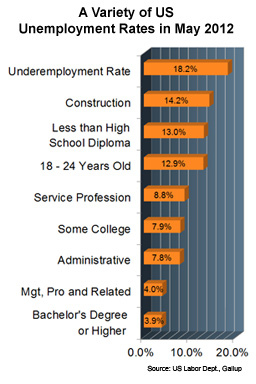
The 8.2 percent national unemployment rate, and even the 3.9
percent bachelor’s degree and higher unemployment rate, seem to
still give employers a false sense of plentiful candidate supply.
It’s like the man stranded on a tropical island, surrounded by salt
water – yet dying of thirst.

In the early days of the recession, we saw amazing candidate
availability. Top candidates truly were victims of circumstance –
doing great work but losing their positions regardless – and became
available on the active candidate market. But a type of reverse
osmosis has had time to set in. The most desirable
candidates found new positions. Today’s unemployed population –
especially the professional space – largely consists of people
whose skills and education doesn’t match with the needs of the
marketplace.

More than 22 percent of the U.S. workforce is in a professional
or related occupation, but less than 11 percent of the 12.2 million
people unemployed in May have professional experience. That
translates to just 1.3 million lawyers, engineers, economists,
computer programmers and more who are unemployed today and actively
looking for a job. If you widen the net to include managers and
financial professionals, the statistic grows to 38 percent of the
U.S. workforce but still less than 19 percent of the unemployed
population.

When talking casually to hiring managers they know how tight
the market is, they understand that of the 1.3 million
professionals who are unemployed, they are unlikely to find that
one person with fifteen years of wind propulsion experience who is
willing to relocate to them. But as soon hiring a candidate leaves
the abstract and interviews are being conducted,managers start
looking at the 8.2 percent unemployment rate or the 17.9
underemployment rate and hold out for a candidate who matches
the detailed profile they’ve written. By holding the line so
tightly, though, they will often overlook someone who could
actually be their perfect match.